

Updated 14 Apr 2026 • 11 mins read
State of the Cloud 2026: Trends, GenAI Growth & FinOps Insights

The 2026 State of the Cloud Report reveals a decisive shift from cost-cutting to value-driven cloud strategy. With 73% hybrid cloud adoption, 81% GenAI usage, and wasted spend rising to 29% for the first time in five years, organizations must prioritize governance, FinOps maturity, and AI-specific oversight. At Opslyft, we see this convergence of complexity and accountability as the defining challenge and opportunity of modern cloud management.
Every year, we look forward to the annual State of the Cloud report. Not just as industry observers, but as engineers and practitioners who live and breathe cloud cost optimization daily. The 2026 edition, built on a global survey of 753 cloud decision-makers, did not disappoint. If anything, it confirmed what we at Opslyft have been telling our customers for the past eighteen months: the cloud game has fundamentally changed.
We are no longer in an era where "moving to the cloud" makes headlines. Organizations have moved. They have settled in. And now, the hard questions have arrived. Questions about value. About governance. About waste. And about whether that shiny new GenAI workload is actually earning its keep or just quietly burning through your budget at 3 a.m. while nobody is watching.
In this article, we break down the most important findings from the 2026 State of the Cloud Report and share our perspective on what they mean for engineering leaders, FinOps teams, and anyone who has ever opened a cloud billing dashboard and felt a sudden wave of existential dread.
The Big Shift: From Cost-Cutting to Business Value
Perhaps the most striking revelation in this year's data is the pivot in how organizations measure cloud success. For the first time ever, "value delivered to business units" has become the number one metric, with 64% of respondents now relying on it. That is a twelve-percentage-point jump from last year. Meanwhile, traditional cost-efficiency metrics actually dropped by six points.
This is a big moment. For years, the entire cloud conversation revolved around one question: "How do we spend less?" Now, the conversation has grown up into something more useful: "How do we spend better?"
From an AI engineer's perspective, this shift makes perfect sense. When your cloud estate hosts everything from mission-critical inference endpoints to experimental fine-tuning jobs, blindly cutting costs can actually hurt you. You need to understand the business outcome each dollar produces. At Opslyft, we have always pushed our customers to connect cloud spend to business KPIs, and honestly, it feels good to see the broader industry finally catching up.
Nearly half of all organizations (49%) are now using unit economics to map cost per service, up from 40% last year. That is not a passing trend. That is a movement.
GenAI Adoption: From Experiment to Everyday Reality
Let us talk about the elephant in the server room. GenAI adoption numbers this year are nothing short of jaw-dropping.
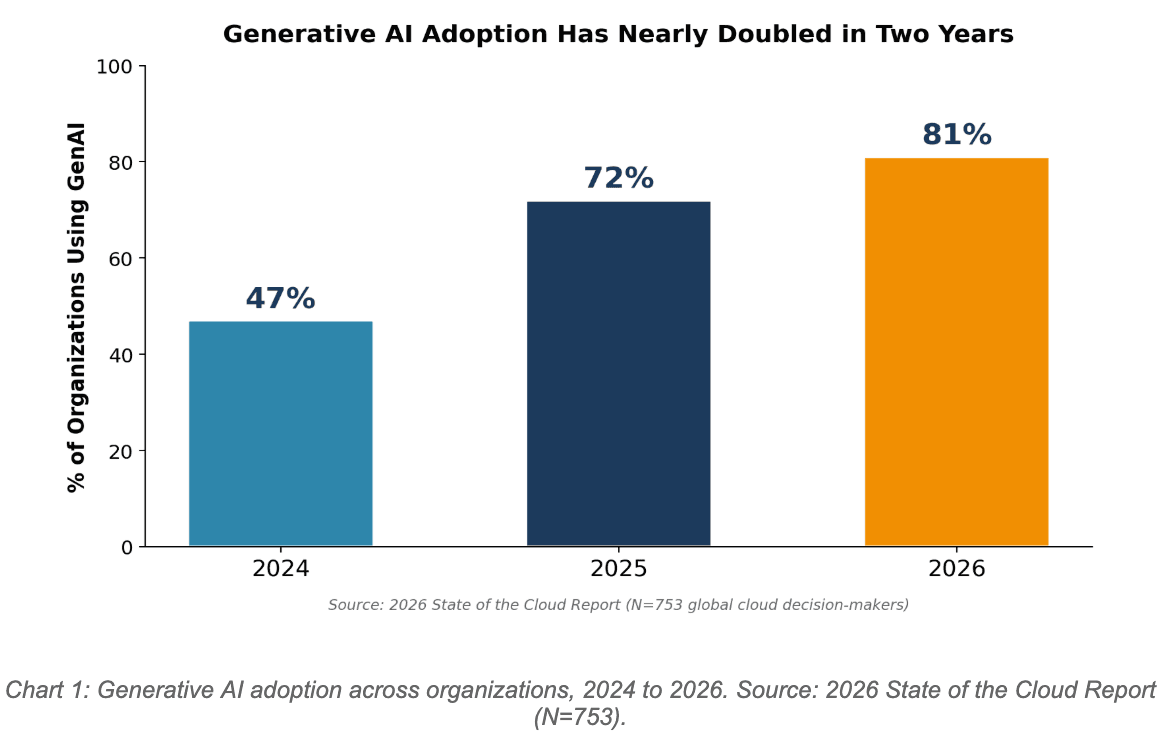
Look at that growth curve. We went from 47% in 2024 to 81% in 2026. And 45% of organizations now say they use GenAI extensively, up from 36% last year. GenAI has also climbed to become the third most widely used public cloud service, jumping from 50% to 58% year over year. That is the largest increase of any cloud service category.
Here is the part that really stands out: every single respondent in the 2026 survey uses GenAI in some capacity. Every. Single. One. We have gone from "should we experiment with AI?" to "how do we govern and optimize AI at scale?" in roughly two years. As folks who have worked in this space for a while, we can confirm that is an extraordinarily fast adoption curve by enterprise standards.
But rapid adoption always brings growing pains. And the report captures them in sharp detail.
The Top Challenges of Scaling AI in the Cloud
When organizations were asked about their biggest obstacles to scaling cloud-based AI workloads, the answers painted a very clear picture.
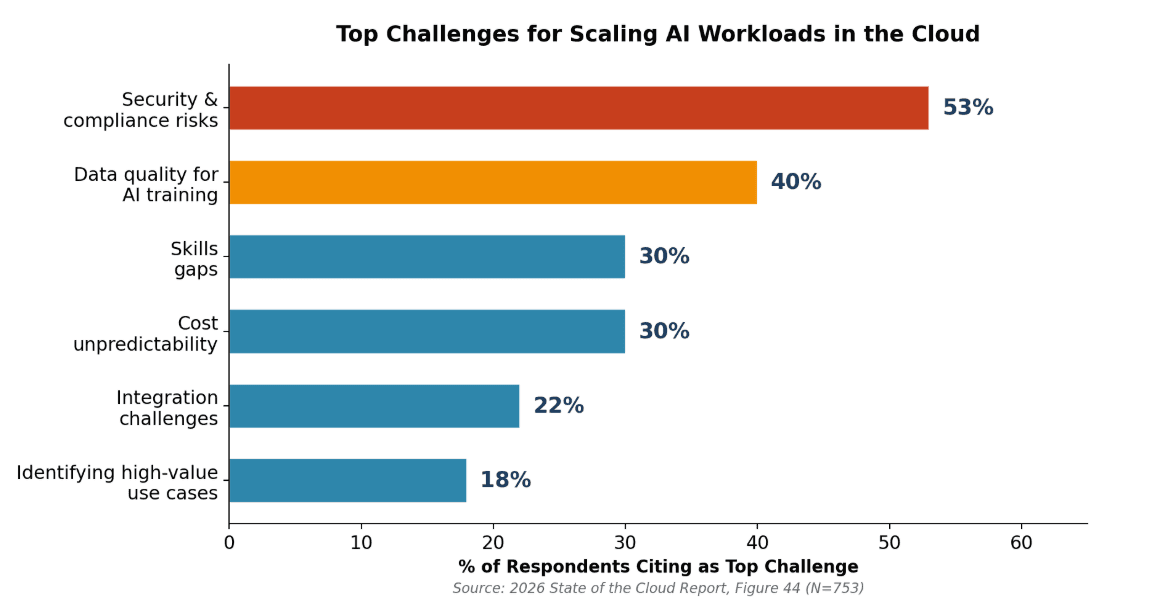
Security and compliance risks top the list at 53%. That number should not surprise anyone, but it should worry everyone. AI models introduce new attack surfaces, data residency concerns, and compliance headaches that traditional cloud workloads simply did not have.
Data quality comes in at 40%, and frankly, this one hits close to home for us. We have a saying at Opslyft: "garbage in, garbage out" has always been true, but at cloud scale, the garbage gets really expensive really fast.
Skills gaps and cost unpredictability are both at 30%, which highlights a dual problem many organizations face. They cannot find enough people who understand AI cost patterns, and the costs themselves behave in ways that are hard to forecast.
Challenge Breakdown with Opslyft Recommendations
| Challenge | % Cited | What Opslyft Recommends |
|---|---|---|
| Security & compliance risks | 53% | Build AI-specific governance frameworks. Do not just extend your existing cloud security policies and call it a day. |
| Data quality for AI training | 40% | Invest in your data pipelines before you invest in your models. Clean data pays for itself many times over. |
| Skills gaps | 30% | Cross-train your FinOps teams on AI cost patterns. You do not need to hire a hundred new people. |
| Cost unpredictability | 30% | AI workloads need different forecasting models than traditional cloud. Start tracking inference costs separately from day one. |
| Integration challenges | Emerging | Moving beyond proof-of-concept means connecting AI services into your existing architecture. Plan for this early. |
| Identifying high-value use cases | Emerging | Not every problem needs a large language model. Sometimes, a well-tuned SQL query is the hero your organization deserves. |
Cloud Waste Is Rising Again, and AI Is Partly to Blame
After five straight years of decline, wasted cloud spend ticked back up to 29% in 2026. That reversal is noteworthy on its own. But the story behind it is even more telling.
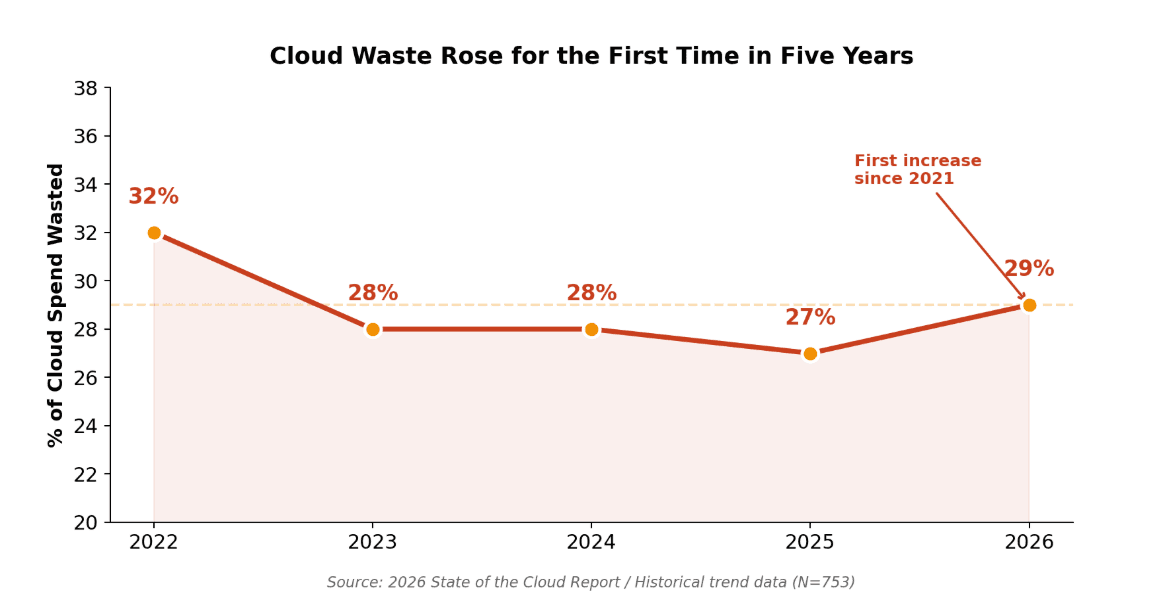
The primary culprits? AI workloads. GenAI services are inherently dynamic and much harder to predict than traditional compute or storage. Training runs spike usage without warning. Inference endpoints scale in ways that do not fit neatly into reserved instance models. And let us be honest here: many teams are still in experimentation mode, which means they are provisioning generously and planning to optimize "later." (Spoiler: "later" often turns into "never.")
Meanwhile, 85% of organizations still identify managing cloud spend as their top challenge. That number has been stubbornly high for years.
A quick note from the engineering side: If 29% of cloud spend is wasted across the industry, and global cloud spending is measured in hundreds of billions of dollars annually, we are collectively setting fire to a truly mind-boggling amount of money. The kind of money that could fund actual space programs. Just something to think about during your next sprint planning meeting.
The good news? Organizations with mature FinOps practices report up to 40% less cloud waste compared to those with basic or ad hoc approaches. The tools and discipline to fix this exist. The question is whether leadership will prioritize them.
Hybrid Cloud Dominates, and the Complexity Is Only Growing
If there was any doubt about hybrid cloud being the dominant architecture, the 2026 data puts that question to rest.
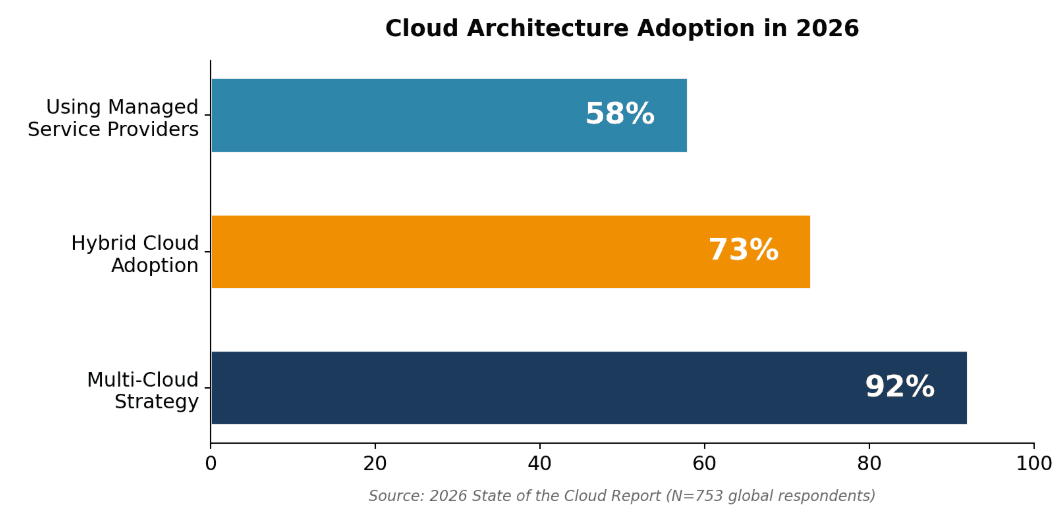
A full 73% of organizations now run hybrid environments, up three percentage points from last year. Multi-cloud is even more widespread at 92%, up from 89% in 2025. And 58% of organizations use a managed service provider to help manage their public cloud.
But here is the nuance that the headline numbers miss: much of this multi-cloud reality did not come from careful strategic planning. Mergers and acquisitions create mixed environments overnight. Different teams pick different providers based on their own preferences. Legacy private cloud infrastructure sticks around because rebuilding applications is expensive and risky.
The result? Unplanned complexity. The kind that makes governance teams lose sleep and makes FinOps practitioners reach for stronger coffee.
At Opslyft, we see this pattern across our customer base every day. Organizations with hybrid estates face a unique challenge: achieving consistent visibility and cost attribution across environments that were never designed to work together. The ones that solve this well are the ones that centralize cloud governance early, not after the complexity has already spiraled out of control.
FinOps and Governance: No Longer a Nice-to-Have
The governance data in the 2026 report tells a story of real, measurable progress. And we at Opslyft find it genuinely encouraging.
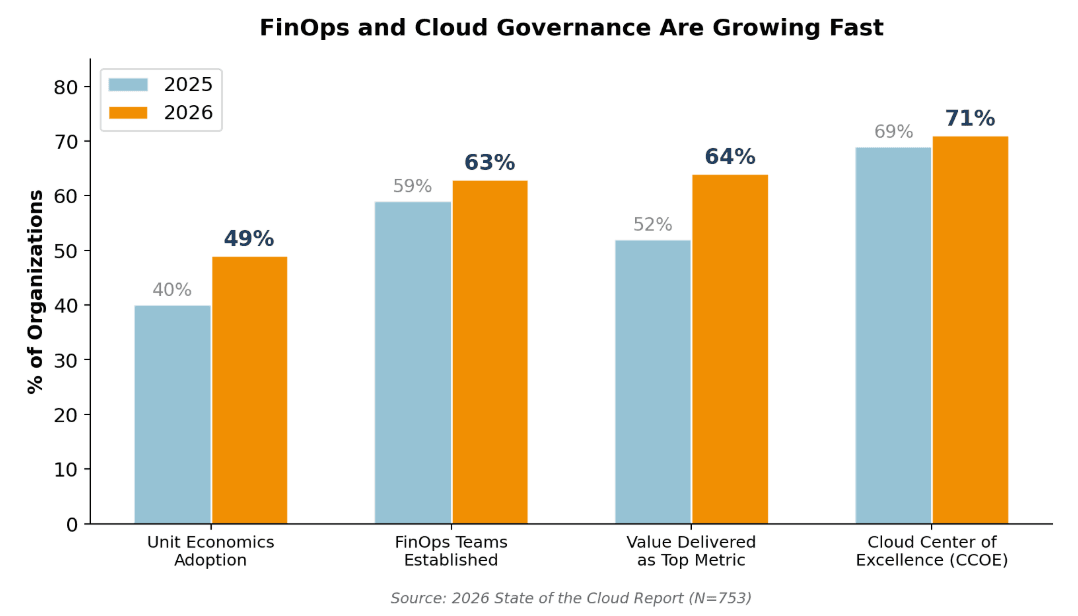
The numbers speak for themselves. CCOE adoption is at 71%, FinOps teams have grown to 63%, and nearly half of all organizations now use unit economics to connect spending to business outcomes. The value-delivered metric jumping twelve points in a single year is a particularly strong signal that FinOps is transitioning from a niche discipline into a core business function.
What we also find encouraging is how the circle of stakeholders is widening. Business units and software asset management teams are becoming active participants in cloud governance. This kind of cross-functional collaboration is exactly what complex, AI-driven cloud environments demand.
A small reality check though: Having a CCOE on your org chart is not the same as having effective centralized governance. The organizations seeing the best results are the ones where the CCOE has actual authority, clear accountability, and a direct line to both engineering and finance leadership. A CCOE that only produces monthly PDF reports nobody reads is a newsletter, not a governance function.
SaaS Spending Is Surging Quietly in the Background
One data point in the report caught our attention more than most: the dramatic upward shift in SaaS spending.
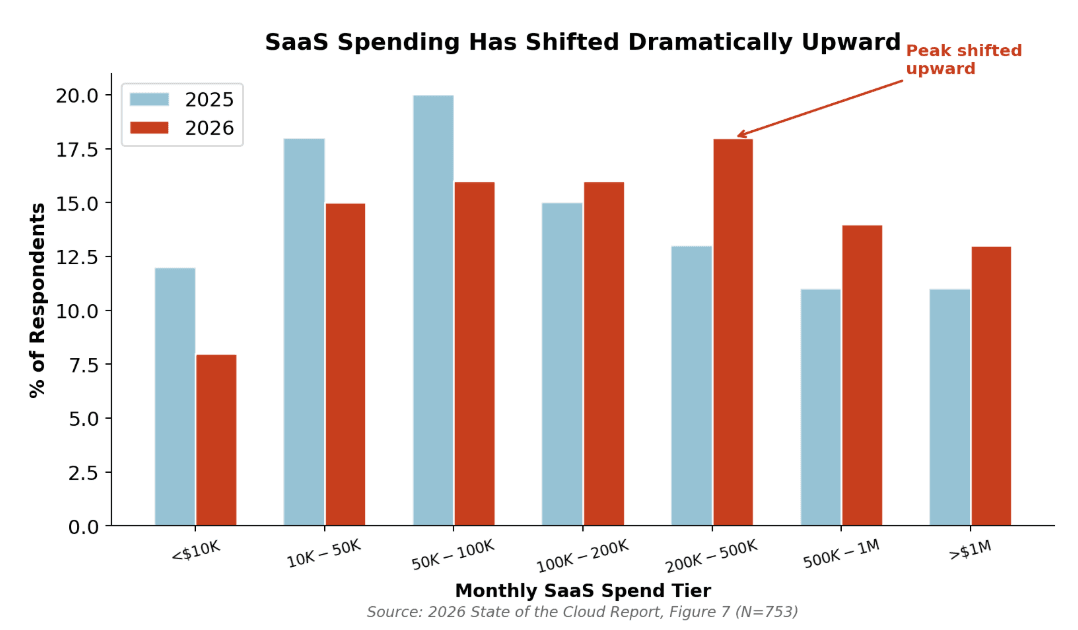
The most common monthly SaaS expenditure range has moved from $50,000 to $100,000 last year all the way up to $200,000 to $500,000 in 2026. Spending in the three lowest tiers dropped by a combined 7%, while spending in the top five tiers climbed by 9%.
This is not subtle growth. It reflects the explosion of AI-powered features within SaaS platforms, the rise of consumption-based pricing models, and the simple reality that modern enterprises depend on an ever-growing constellation of software services.
For smaller businesses, the picture looks quite different. About 73% of SMBs spend less than $50,000 per month on SaaS, underscoring the wide gap between enterprise and SMB cloud economics. Industry analysts forecast SaaS spending to grow by an additional 15% through 2026, making proactive SaaS management essential rather than optional.
Enterprise vs. SMB: A Two-Speed Cloud Economy
The spending and adoption patterns in this year's report reveal a cloud economy operating at two very different speeds.
| Metric | Large Enterprises | SMBs |
|---|---|---|
| Monthly public cloud spend | 76% spend over $5M/month | Majority under $50K/month on SaaS |
| Public cloud workload adoption | Highly mature, multi-cloud | Rose from 55% to 63% YoY |
| Hybrid cloud usage | Near universal | Growing, driven by flexibility needs |
| FinOps maturity | Dedicated teams with clear ownership | Often ad hoc, reactive processes |
| GenAI adoption intensity | 45% use it extensively | Increasing but more cautious |
This divergence matters because the tools, strategies, and governance models that work for a Fortune 500 company do not necessarily translate to a mid-market firm with a fraction of the headcount. At Opslyft, we believe the next wave of cloud management innovation needs to focus on making enterprise-grade visibility and optimization accessible to organizations of all sizes. Good cost intelligence should not be a luxury reserved for the biggest spenders.
Sustainability: Slow Progress, But Progress Nonetheless
An often-overlooked section of the report deals with sustainability. Right now, 59% of organizations either have or plan to have a defined sustainability initiative that includes tracking the carbon footprint of their cloud usage. Among European respondents specifically, that number rose from 43% to 47% year over year.
Progress is real, but it is incremental. Regulatory changes have slowed some momentum, with reporting requirements being narrowed to only the largest organizations. Still, the direction is clear: sustainability is becoming an expected part of responsible cloud governance, not just a checkbox on a corporate social responsibility page.
From an engineering standpoint, sustainability and cost optimization are often two sides of the same coin. Reducing wasted compute is not just good for the budget. It is good for the planet. We think this alignment will end up driving sustainability adoption faster than regulation alone ever could.
What This All Means: Our Five Key Takeaways
After spending serious time with this year's data, here is what we at Opslyft believe matters most:
1. Value measurement is the new north star. If your organization still measures cloud success purely in terms of cost savings, you are falling behind. The leading organizations are tying every cloud dollar to a business outcome.
2. AI governance is not optional. It is urgent. With 81% of organizations now using GenAI and waste rising for the first time in five years, the need for AI-specific governance, cost forecasting, and security protocols has never been more pressing.
3. Hybrid and multi-cloud complexity will only grow. The 73% hybrid adoption rate is not a plateau. It is a waypoint. Organizations need to invest in unified visibility across all environments or risk losing control of their estates entirely.
4. FinOps must evolve from cost-cutting to value engineering. The shift from cost-efficiency metrics to value-delivered metrics is the defining transformation of this era. FinOps teams that embrace this evolution will become genuine strategic partners to the business.
5. Start governing AI costs on day one, not day one hundred. The organizations that bake cost awareness into their AI development pipelines today will be the ones that scale AI sustainably tomorrow.
Conclusion
The 2026 State of the Cloud Report tells the story of an industry at an inflection point. Cloud computing is no longer about migration or adoption. Those chapters are written. The current chapter is about maturity, accountability, and squeezing maximum business value from increasingly complex, AI-powered environments.
At Opslyft, we see this as a moment of tremendous opportunity. The organizations that invest in solid governance, mature FinOps practices, and intelligent cost optimization today are the ones that will turn cloud complexity into a competitive advantage. Those who treat these as afterthoughts will find themselves spending more, understanding less, and steadily falling behind.
FAQs
The shift is from cost-cutting to value measurement. Organizations are now prioritizing business outcomes over savings, focusing on what cloud investments actually deliver.
AI workloads introduced unpredictable usage, experimentation-driven overprovisioning, and complex pricing models, making optimization and forecasting more difficult.
Adopt AI-specific governance with clear visibility, built-in compliance checks in deployment pipelines, and cross-functional oversight across teams.
FinOps is more relevant than ever, evolving into a strategic function that links cloud spending to business outcomes and guides smarter investment decisions.